The EU Pharma Package Is Almost Law: What Changes for Marketing Authorisation Holders
By Dr. Mohamad Toutounji •October 2, 2026
The biggest rewrite of EU pharmaceutical law since 2004 is almost done. On 28 September 2026 the Council approved the texts of the "pharma package", a new Directive and a new Regulation replacing Directive 2001/83/EC and Regulation 726/2004. The European Parliament's second-reading vote is scheduled for 19 October 2026. Here is what changes, and why it matters well beyond Europe.
Figure 1. From proposal to application. Member States get two years to transpose the Directive.
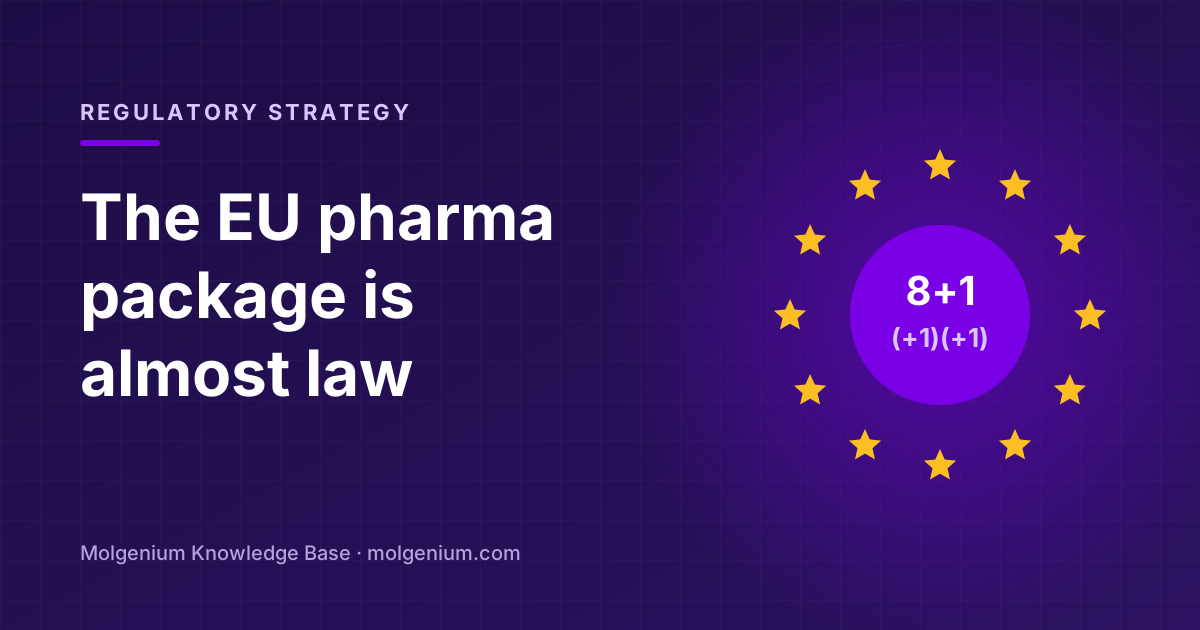
Regulatory protection: from 8+2+1 to 8+1(+1)(+1)
Today a new active substance in the EU gets eight years of data protection and two years of market protection, plus one possible year for a new indication. Under the package, the baseline becomes eight years of data protection and one year of market protection, with up to two further years available under conditions. The structure rewards companies that meet EU policy goals, rather than granting the same term to everyone.
Figure 2. Dashed years are conditional. Exact conditions are set out in the final legal texts.
Six changes to know
Antimicrobial voucher
A transferable exclusivity voucher grants 12 extra months of data protection to another product. It is valid for five years, usable once, and cannot be used for a medicine with more than €490 million in annual EU sales in its first four years.
Orphan exclusivity
Reduced from ten to nine years in general, with up to eleven years for "breakthrough" orphan medicines.
Broader Bolar exemption
Generic and biosimilar companies may prepare health technology assessment, pricing and reimbursement and public procurement bids before protection expires.
Supply obligations
Member States can require sufficient supply, pricing applications or participation in procurement. Failing to meet such obligations within three years can cost market protection.
Environmental risk
Authorities may impose post-authorisation environmental risk assessment studies.
Long runway
With two years for transposition, the new rules are expected to apply around the end of 2028 or early 2029.
Why MENA companies should care
Many authorities in the region rely on EU decisions, reference EU product information or require proof of EU approval. Changes to EU protection periods and launch obligations will shape when originators launch, when generics and biosimilars can enter, and how companies sequence filings between Europe and the Gulf. Regional generic companies exporting to Europe gain an earlier start on market access work through the broader Bolar exemption. Originators will look harder at launch sequencing, since supply obligations are now tied to protection.
STRATEGY CHECKLIST
1Re-run loss-of-exclusivity models for EU products filed after the new rules apply.
2Map which of your target markets rely on EU decisions, and how launch sequencing affects them.
3For generics and biosimilars, plan HTA, pricing and tender preparation earlier under the wider Bolar scope.
4Watch the final published texts: conditions for the extra protection years matter more than the headline numbers.
Molgenium supports regulatory strategy across EU and MENA markets. Talk to us about what the package means for your portfolio.