Made in the Gulf: The Pharma Localisation Wave Reshaping MENA
By Dr. Mohamad Toutounji •September 29, 2026
The Gulf has decided that medicines are strategic infrastructure. Saudi Arabia first set a target of 40% local pharmaceutical manufacturing a decade ago, and in 2026 the push toward local generics, active ingredients and biosimilars is stronger than ever. The gap between ambition and reality is still large, and that gap is where the opportunity sits.
Figure 1. The 40% target first appeared in the 2016 National Transformation Programme (from an 18% baseline). Industry analyses in 2026 put the local share at about one fifth of demand.
Why localisation is back at the top of the agenda
Supply security
Pandemic-era shortages showed how exposed import-dependent markets are. Medicines are now treated like food and energy security.
Economic diversification
Pharma is a high-skill, high-value industry that fits Vision 2030 and similar plans across the GCC.
Regulatory momentum
The SFDA is streamlining generic and biosimilar registration, and new authorities such as the UAE's Emirates Drug Establishment are reshaping the market.
Science is lowering barriers
Analytics-led biosimilar pathways in the US and EU reduce the cost of entering complex products.
Moving up the value chain
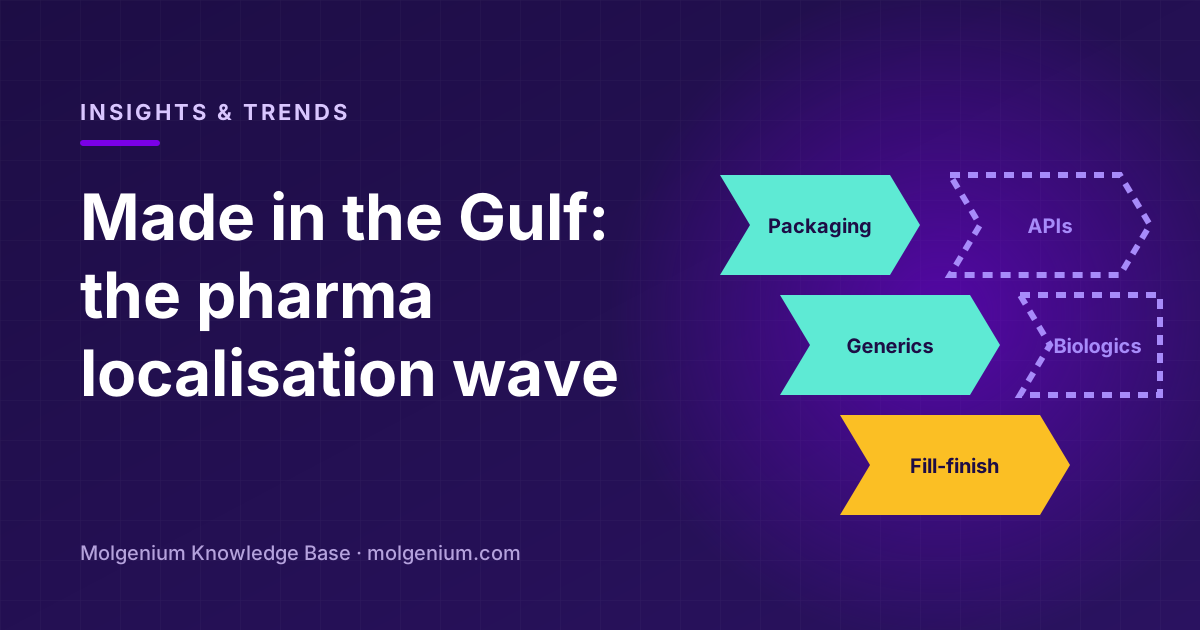
Most localisation so far has happened at the simpler end: secondary packaging, finished dose manufacturing of established generics. The harder and more valuable steps are still largely imported.
Figure 2. A simplified view of the regional value chain. Real capacity varies by country and company.
What decides who succeeds
Building a factory is the easy part. The projects that reach export-grade quality share four things.
1Technology transfer done properly. Licensing a product is not the same as transferring knowledge. A structured transfer with clear acceptance criteria is what makes the first commercial batches succeed.
2GMP designed for export from day one. A site built only to pass a local inspection will struggle with EU or FDA standards later. Designing to PIC/S expectations from the start costs less than retrofitting.
3People. Qualified persons, validation engineers, QC analysts and pharmacovigilance staff are the real bottleneck. Training pipelines need to start years before the plant opens.
4Lifecycle systems. Quality, safety and regulatory systems that can handle a growing portfolio across several national authorities.
The next wave of localisation will be judged not by how many factories open, but by how many of them can export.
Molgenium works at exactly these points: technology transfer, GMP design and audits, training and regulatory strategy for MENA markets. Read our tech transfer playbook on this blog, or talk to us about your localisation project.